
As we begin a new year, many of us feel the pull to start fresh—new habits, new goals, a “better” version of ourselves. Often, that pressure shows up as dieting or fixating on weight. I’m here to remind you that caring for yourself and growing as a person does not require a diet or constant body monitoring.


             Research consistently shows that diets don’t work long term. In fact, about two-thirds of people who diet regain all the weight they lost—and often more. Dieting can slow your metabolism, increase long-term weight retention, and negatively affect mental health. It often leads to obsessive thoughts about food, guilt when the diet becomes unsustainable, and increased anxiety around meals and social situations. Over time, diets teach us to judge ourselves based on what we eat, how much we weigh, and whether we’re being “good” or “bad.”


             This year, consider taking a more holistic approach to caring for your body and your relationship with food.

What Is Intuitive Eating?

             Intuitive Eating is a framework that combines mindful eating with awareness of emotional eating patterns and cognitive distortions. At its core, it focuses on rebuilding trust in your body.


             Instead of allowing diets to dictate what, when, and how much you eat, Intuitive Eating helps you reconnect with your internal cues—hunger, fullness, satisfaction, and how food makes you feel. The goal isn’t control; it’s respect. By tuning into your body, you can improve your relationship with food and learn to nourish yourself in a way that feels supportive and sustainable.


             Intuitive Eating is made up of 10 core principles. It’s important to know that this process is highly individualized. You may move back and forth between principles, and that’s completely normal. Intuitive Eating is not a linear path.


             It’s also important to clarify that Intuitive Eating is not a weight-loss method. While some people naturally return to their body’s set-point weight, pursuing weight loss as a goal can interfere with your ability to listen to your intuitive signals.


Below is an overview of the principles:


  1. Reject the Diet Mentality

             Acknowledge the physical, psychological, and emotional harm caused by dieting. Let go of beliefs centered on willpower, obedience, and fear of failure. Consider removing tools like the scale, which do not accurately reflect health or body composition. Instead, practice self-compassion and affirmations such as:
“I trust my body. My weight is not my primary goal or my measure of progress.”


  1. Honor Your Hunger

             Consistently fuel your body with adequate energy—especially carbohydrates—to prevent intense hunger and overeating. When your body knows food is available, trust can begin to rebuild. Ask yourself, “Am I hungry?” and notice signals like stomach growling, lightheadedness, difficulty concentrating, irritability, or headaches.


  1. Make Peace with Food

             Restricting certain foods often leads to deprivation, binge eating, and guilt. Give yourself unconditional permission to eat. Release the belief that foods are inherently “good” or “bad,” and recognize how these labels affect both your food choices and your self-worth.


  1. Challenge the Food Police

             The “Food Police” is the inner critic formed through dieting and rigid food rules. It judges what you eat and reinforces guilt and shame. Developing self-awareness helps quiet this voice and creates space for more intuitive choices.


  1. Feel Your Fullness

             Learn to recognize and respect your body’s signals for fullness. Mindful eating—paying attention to taste, texture, and satisfaction—can help you notice when your hunger begins to fade.


  1. Discover the Satisfaction Factor

             Satisfaction plays a powerful role in eating. When you eat what you truly want in a relaxed environment and allow yourself to enjoy it, you often feel content with less. Satisfying eating includes slowing down, savoring each bite, and reconnecting with pleasure.


  1. Cope with Emotions Without Using Food

             Emotional eating exists on a spectrum—from comfort and distraction to self-punishment. Rather than judging yourself, focus on addressing emotions like stress, boredom, loneliness, or anger through supportive outlets such as journaling, talking with a friend, taking a bath, or working with a therapist.


  1. Respect Your Body

             Accept your genetic blueprint and treat your body with dignity. Respect looks like feeding yourself adequately, wearing comfortable clothing, moving in ways that feel good, and offering yourself kindness and care.


  1. Movement for Joy, Not Punishment

             Exercise should never be used to “earn” food or compensate for eating. Focus instead on how movement makes you feel. Mindful movement can reduce stress, increase strength and endurance, support heart and bone health, and enhance overall well-being—while also being enjoyable.


  1. Honor Your Health with Gentle Nutrition

             Choose foods that both nourish your body and satisfy your taste buds. Gentle nutrition emphasizes balance over perfection. Research shows Intuitive Eating is associated with improved nutrient intake, greater food variety, reduced disordered eating behaviors, and better overall health outcomes.


Understanding Internal Family Systems (IFS)


            There are many different types of treatment modalities in the mental health realm which aim to understand individuals, the origins of their symptoms, and to increase self-awareness while breaking maladaptive behaviors.


            One of those modalities is Internal Family Systems (IFS) which was developed by Richard Schwartz, Ph.D., LMFT. The premise of the approach is that the human psyche is not monolithic but instead composed of various parts and a Self. The theory operations under the notion that all parts have a designated function to protect and they are all good. The Self is the essential core which is a compassionate presence and carries the ability to be an active leader if it is in control.


            Internal Family Systems therapy focuses on two primary parts of a person, their vulnerable parts (aka their Exiles) and their protective parts.


           Vulnerable parts are frozen in times of painful emotional states which develop negative beliefs about themselves. Exiles are younger and of varying ages.


Protective parts have a primary job to protect the vulnerable parts from being activated in the present day and to protect us from being flood by the pain and negative emotions that the vulnerable parts carry. Protective parts are often the age we were when they first had to take on their roles.


The origins of an Exile is traced back to a wounding experience which causes them to be stuck in the past. When a wounding experience happened in the past the psyche “exiled” or locked away the painful part in order to reestablish homeostasis. This keeps the individual from feeling too overwhelmed or paralyzed by pain in order to keep functioning day to day. The painful emotional state and the negative beliefs internalized by the Exile is called a burden. They are often desperate in their attempts to be acknowledged and cared for. IFS aims to bring Exiles out of the past and into the present where their burdens can be properly released and their essential qualities can be reinstated.


If an Exile is activated in the present day, the Protective parts assume roles which are more extreme than their true nature in order regain balance. Even though some of the methods that the Protective parts take on can have harmful impacts, their intentions are always good. There are two types of Protective parts, Managers and Firefighters.


Managers work proactively by doing whatever they can in order to keep the exiled parts under control. Managers are future orientated. They are focused on planning, controlling, and achieving in order to keep things in check. They can be people pleasers, critical, and rigid. People who have more extreme Manager tactics often are more immersed in the intense effects of the Exiles.


Firefighters work reactively by jumping in to lock away exiled parts that appear in the present day. Firefighters are present orientated and are not focused on consequences of their actions. They are more impulsive, compulsive, and have addictive behaviors. They utilize dissociation in order to distract, comfort or numb out until the Exile part is locked back up. Once that is accomplished the balance is restored.


There is often conflict between Managers and Firefighters because the two protective parts have conflicting points of view. For example: a person struggling with disordered eating may have a Manager who tells the person that they are worthless and disgusting in order to stop overeating so the person is more accepted in society. Managers will make efforts to “eat clean”, restrict, and over exercise. With time they become tired of their rigid behaviors and slip up which triggers the Firefighter to step in. The Firefighter will engage in a binge episode to “put out the fire” which initially feels good and relieving. But as soon as the binge eating episode is over, the Exile resurfaces with feelings of shame and guilt from the past.  


            Everyone possesses a Self who is the optimal leader because it possesses the 8 C’s (calmness, curiosity, compassion, confidence, courage, clarity, connectedness and creativity). The Self becomes covered up by the various parts, the Managers, and Firefighters. IFS works towards healing the relationship between the parts and the Self and unburdening the Exiles. Therefore, the goal of IFS therapy is to bring the internal system into balance, with parts that are consistent with their true nature, and the Self as the leader.


In treatment, this looks like the therapist guiding the individual to understand each part. This is achieved by the 6 F’s:

Finding a particular part and identifying the physical sensation that it stirs up in the body.

Focusing on the part.

Fleshing it out by noticing it’s age, emotions, appearance, etc.

Feelings that come up by the individual towards the part.

beFriending the part by utilizing self-compassion.

Fears that the part has if they don’t do their job.


           It takes time and effort for trust to build with each part. After working with the Protective parts, an individual is granted access to the Exile. Approaching the Exile with curiosity, listening to their story, and witnessing their pain in a way that was not acknowledged when they originally experienced the painful wounding experience is key. After each part is seen, heard, acknowledged, and valued by the Self it is able to become unburdened and properly connected.


           Internal Family Systems is different from other modalities of treatment because it focuses on the experiences individuals go through instead of pathologizing them. IFS acknowledges self-harm, substance use, and promiscuous behaviors as parts trying to protect the individual. Therefore, the goal isn’t to just manage symptoms with medications and interventions but to focus on the “root” of the individuals experience to heal them. IFS incorporates components spirituality and belief that individuals have the capacity to heal.


Citation and Resources:


Schwartz, R. C. (2021). No bad parts: healing trauma & restoring wholeness with the internal family systems model . Sounds True.


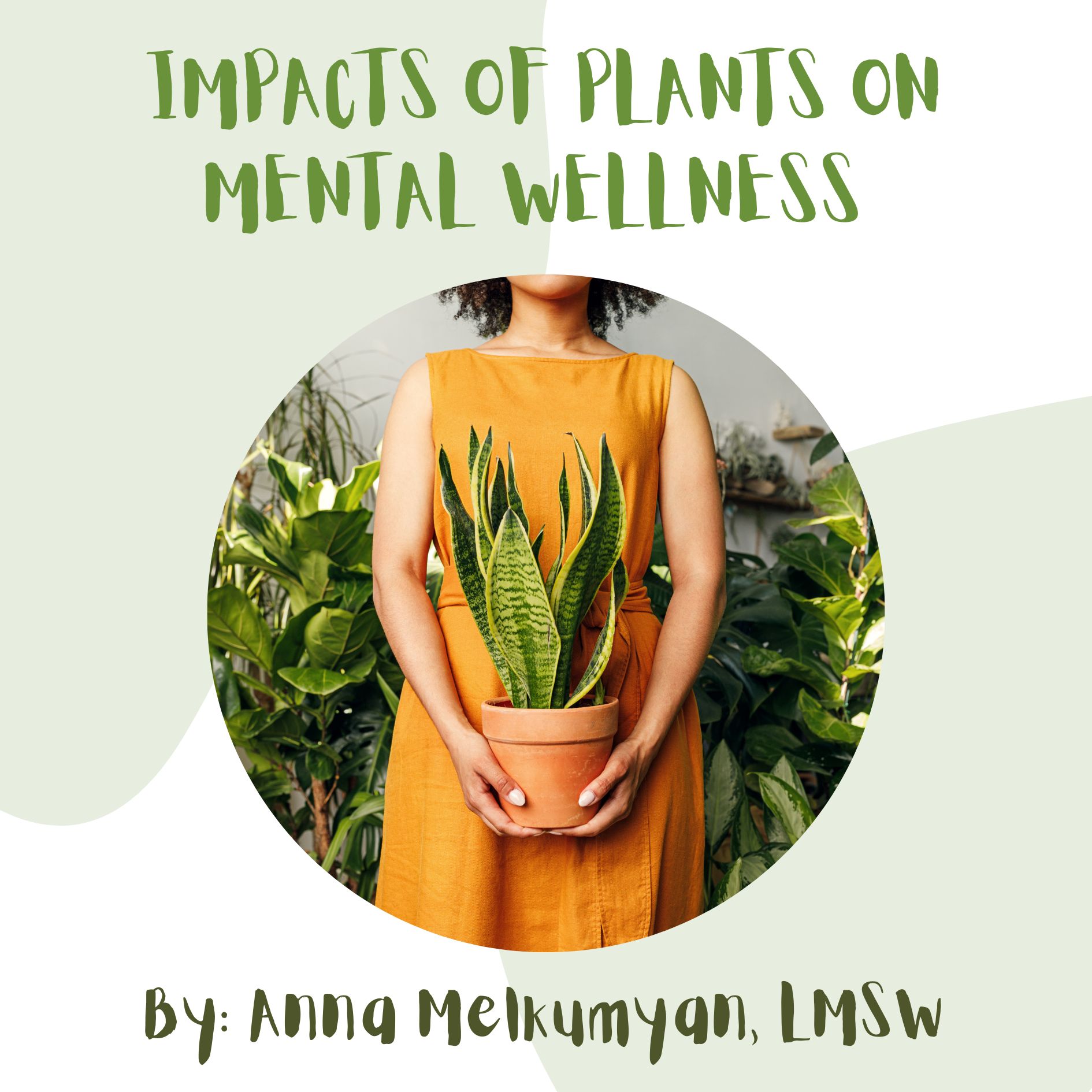
Impacts of Plants on Mental Wellness

by Anna Melkumyan


If you’ve visited Blooming Minds Therapy, you’ve probably noticed several hundred plants scattered around our practice. We house a variety of foliage plants in each space not only for aesthetic value but to promote the positive impacts of plants (and plant care) on mental wellness. I often utilize plant metaphors when treating my clients because there is a high correlation between the needs of plants and those of humans.

In 2020, Blooming Minds Therapy underwent a major expansion of its practice and the construction of its space, during the height of pandemic. During this time, I was also navigating a lot of changes in my personal life which contributed to an increase of my own depression and anxiety symptoms. With so much uncertainty in the world and the pressure to keep moving forward I quickly realized that my previous coping skills needed some upgrading.

Plants became my outlet because they allowed me to slow down, held me accountable to care for them while I struggled caring for myself, and provided me with stimulation to keep learning and growing my collection. I share my experience in hopes of helping others find an outlet to improve their mental wellness. Here are some lessons I’ve learned through the care of plants:

Mindfulness

Caring for plants often times means slowing down and being present during the process of assessing their needs. If the soil is bone dry, it may take a few extra minutes to properly water and aerate the soil. During this period, you can utilize coping skills learned in therapy such as grounding yourself in the experience. If you allow yourself to focus on how the soil transforms, what it feels like to touch the soil with your fingers and acknowledge the smell you notice, you are probably less focused on your anxious thoughts. You could also focus on your own breath work as you prune away the dead foliage. Taking a deep breath in as you count to 3
and exhaling as you count to 5 can sooth the physical sensations of anxiety in the body.

Resilience

Like humans, plants are very resilient and can be forgiving if proper adjustments to their environment are made. I never give up on dying plants because I’ve learned the art of propagation. This means that you can create a new plant by cutting a node off the mother plant and placing it in water to root over time. Similarly, we can make changes to improve the quality of our lives. This could mean improving our sleep hygiene, spending more time with our supports, and adding more movement to our day. Sometimes plants cannot simply be propagated because all the foliage is damaged or dead. But odds are the root system beneath the surface is still viable and can produce new growth. I’ve learned that a clear plastic cup placed over the soil can create a greenhouse effect to help the plant grow back. Similarly, we sometimes have to make more drastic decisions to ensure survival and growth. This could mean ending an unhealthy relationship, changing jobs, or starting a new medication to manage mental health symptoms.

Consistency

When we plant seeds or start a new habit, we don’t see results right away. Which means that we have to have faith in the importance of routine and consistency to see results. Educating yourself on how to care for each plant, when to water it, recognizing the type of light it needs, how often to fertilize it and how much humidity to add, increases the chances of new growth. The satisfaction of seeing a plant sprouting new foliage often increases serotonin levels and creates a positive reinforcement cycle. But being consistent with a new routine can be challenging especially if you are struggling with a mental health illness. It helps to monitor progress by journaling, attending weekly therapy, and reflecting on how the changes you’ve been making are impacting your emotions, thoughts, and behaviors. Holding yourself accountable with a tracking system, the support of trusted friends or family, and adding one new habit at a time can be beneficial.

Compassion

Being compassionate is key when caring for plants and yourself. I’ve killed many plants over the years and learned a lot of lessons along the way. I’ve accepted that each plant goes through its own lifespan. No matter what I do to encourage it to thrive year round, it will eventually hibernate for a season or possibly die completely. Sometimes plants become sick with mites or fungal infections and require treatment I wasn’t anticipating. I’ve had to course correct by isolating, researching, and treating before returning to the original routine.

Similarly, a lot of unexpected things occur each day which can create a sense of helpless. Our society is consistently going through a new crisis, we are all bombarded with a lot of information and no time to process the things happening outside of our control. Being self-compassionate and recognizing that we all have limitation can be a helpful mindset to adopt. Being patient with yourself and recognizing that you are doing the best you can with the resources you have available can help quiet the negative cognition that is associated with depression. We all require time to rest and recharge before we are able to thrive again.

Lastly, let’s look into the research of points I have shared. Lee MS, Lee J, Park BJ, Miyazaki Y (2015) confirm through their research that “active interaction with indoor plants can reduce physiological and psychological stress compared with mental work. This is accomplished through suppression of sympathetic nervous system activity and diastolic blood pressure and promotion of comfortable, soothed, and natural feelings.” Additionally, there is a lot of research confirming positive impacts of mindfulness on mental health conditions such as depression, anxiety, addiction, and chronic pain. Goldin et al. (2016) research shows that use of mindfulness interventions is better for reducing and managing anxiety symptoms compared to Cognitive Behavioral Therapy (CBT).

Overall, plant care can be a powerful experience allowing space to implement mindfulness techniques and creating a calming oasis which can promote mental wellness. It can be incorporated into a weekly routine, increase serotonin levels and help engage in a community with other plant enthusiasts.

Citations

Goldin PR, Morrison A, Jazaieri H, Brozovich F, Heimberg R, Gross JJ. 2016. Group CBT versus MBSR for social anxiety disorder: a randomized controlled trial. J. Consult. Clin. Psychol. 84(5):427–37 Lee MS, Lee J, Park BJ, Miyazaki Y. Interaction with indoor plants may reduce psychological and physiological stress by suppressing autonomic nervous system activity in young adults: a randomized crossover study. J Physiol Anthropol. 2015 Apr 28;34(1):21. doi: 10.1186/s40101-015-0060-8. PMID: 25928639; PMCID: PMC4419447.


What is therapy?

An overview for potential clients

by Mei Bresnahan


What Is Therapy?

Therapy is a space for clients to receive individual support & guidance from a licensed mental health professional, so they can actively participate in their own healing. The goal of therapy is for clients to gain the insight & abilities necessary to:
– Understand & resolve their problems
– Manage, reduce, and/or eliminate mental illness symptoms
– Reach their mental health related goals
– Obtain a sense of well-being

What Are The Basic Elements Of Therapy?

Support
The therapist actively listens to the client, providing empathy, reflection & validation. The client feels heard & understood, and is able to build a trusting relationship with the therapist.

Impartiality
The therapist tries to remain impartial, avoid giving directives, and refrain from passing judgment on the client. In this way, therapy differs from other dynamics such as friendship. It provides the client with a relatively unbiased perspective, which they can use to form their own opinions and decisions.

Confidentiality
Therapy is a confidential space protected by legal & professional mandates. The client is free to share almost anything they need to in order to heal, knowing the therapist will not share this information except under certain circumstances. If such an exception applies (ex: imminent danger to self/others), the therapist would inform the client that confidentiality must be breached for legal & ethical reasons.

Active Engagement & Collaboration
Therapy is a dynamic process that involves engagement & collaboration between therapist and client. During session, the therapist offers insight, support and skills training rooted in evidence-based practices (ex: Cognitive Behavioral Therapy) and tailored to the client’s specific needs. For therapy to work, the client must also be an active participant. During session, the client provides topics of concern, participates in discussion, and gives feedback as needed. Outside of session, the client reflects on lessons learned, practices new skills, and completes any ‘homework’ if assigned. If you are a new client and/or unsure how to participate, let us know and we are happy to help!

What Does Therapy Look Like?

Structure

Therapy sessions are 50 minutes long, and can be held in-person or online depending on therapist availability. During the ‘intake’ (first) session, the therapist asks background questions to gain a broader understanding of the client’s situation. In the second session, therapist and client collaborate to create a treatment plan; this plan has clear goals and objectives to guide the course of therapy. Further sessions are structured based on the therapist’s style and client’s preferences.

Frequency & Progress
– Beginning: Initially, therapy is usually scheduled on a weekly or every-other-week basis. During the first few sessions, therapist and client get to know each other and build a working relationship. While the client may not notice immediate change, this rapport building is essential to successful treatment.

– Ongoing: As therapy continues, the client starts making progress. It is important to note that progress is nonlinear (goes up & down), because healing is complicated and naturally fluctuates over time. Once progress is maintained, the client needs less support and sessions are scheduled less frequently (ex:
once a month).

– Termination: Eventually, the client progresses to the point of no longer needing support, and treatment is terminated. This ‘graduation’ is the final goal of therapy: for the client to achieve and maintain their well-being independently. The duration of treatment (i.e., time until termination) depends on the individual client and their circumstances (ex: commitment to change, support system, etc.). Some clients may graduate within 3 or 4 months; others may require one or more years.

Cost
Session cost will depend on how the client pays (direct/private pay vs insurance company). For the client using insurance, fees will vary based on their individual policy. For further details, please review our registration paperwork and (if using insurance) contact your provider.

4 Things Your Therapist Wants You To Know

1. In order for therapy to work, you must attend & participate
For therapy to be successful, the client must attend sessions regularly and actively participate in treatment (ex: engage in discussion, practice skills outside of session). If you have difficulty attending or participating, let your therapist know and they will do their best to support you (ex: brainstorm ideas). Please note that therapists can only provide support during sessions. If you do not schedule or show up to therapy, your therapist cannot beg or force you to attend.

2. Therapy is not a magic cure-all
If problems were a mountain, the therapist would not carry the client up or tell them exactly how to climb. The therapist would help the client find hand & footholds, and the client would test these out to scale the mountain. In this way, therapy itself will not resolve your problems for you. Instead, your therapist will help you learn coping skills and identify solutions, and you are the one who will change your life!

3. Therapy is not always fast or easy, but it is worth it!
Progress in therapy can start slow and/or fluctuate over time, because healing is a complicated process. If you do not immediately see improvement, do not lose hope! Imagine blowing up a balloon: it may grow slowly, stall, or sometimes even shrink if you lose your grip. But in the long-term, you will inflate the balloon to a bigger size than it was before. Similarly, therapeutic progress can fluctuate over time; these ‘expansions’ and contractions’ are normal parts of healing & growth. Therapy is not always comfortable or easy—sometimes painful emotions or memories may arise in or after session. This is normal and an often-necessary part of healing, like changing a bandage. That being said, too much pain may impede healing, so let your therapist know if you ever feel overwhelmed. Overall, clients who participate in therapy and communicate their concerns, find therapy to be extremely helpful in giving them insight, new skills & tools to use, and receiving support they may not get elsewhere.

4. Give us feedback!
If you are confused, unsure or having any difficulties with treatment, please communicate this to your therapist. Tell us what you like and don’t like, what’s working and what is not. We are open to feedback and want to support you the best we can! And we can only help if we know what is going on.